
header-image

Thomas End of Tenancy Cleaning Service in London

End of lease specialists

Blog

What Tenants Can Refuse to Clean in a Rental Property Under UK Tenancy Law

You owe your landlord a clean flat. You do not owe them a professionally cleaned one, and you do not owe them one in better condition than the day they handed you the keys. There’s a ceiling on what a tenant has to clean, and a stack of jobs that were never theirs to begin with. The gap between what landlords ask for and what the law actually makes you do is where deposits quietly disappear, taken from people who never knew they were allowed to say no.

Can a landlord make you pay for professional cleaning?

No. They can ask. You can decline, and the law stands behind you.

The Tenant Fees Act 2019 killed the professional-cleaning clause stone dead in England. Before it, a tenancy agreement could demand you hand the flat back professionally cleaned, receipts and all, and you were stuck with it. The Renters’ Rights Act rewired English tenancies in May 2026 – fixed terms gone, every let now a rolling assured tenancy, Section 21 abolished – but it left the cleaning rules exactly where the 2019 Act put them. A landlord cannot make professional cleaning a condition of the tenancy, and cannot charge you a fee for one. What you owe instead is simpler and cheaper: return the property to the standard of cleanliness it was in when you moved in. If that standard was “professionally cleaned,” you have to match it – with your own two hands and a free Sunday if you like. Nobody can force you to pay a company to do what you’re willing to do yourself.

The receipt myth is worth strangling here. Landlords and agents love to imply that only a professional clean with an invoice stapled to it will satisfy a check-out. It won’t, and it needn’t. An inventory clerk assesses whether the flat is clean by looking at it, against the check-in, and never once asks to see a receipt. A flat you scrubbed yourself to the same standard passes exactly as well as one that cost you £180. That was never a requirement, and the £180 stays in your pocket.

What you do still owe is real, so don’t overread this. The oven, the extractor filter, inside the kitchen cupboards, the limescale round the taps, behind the white goods if you can shift them – the standard is genuine and the check-in inventory is the yardstick. Clean to it. Photograph what you’ve done and keep the photos, and if a professional-cleaning charge lands on your deposit regardless, refuse it and let the deposit scheme’s adjudicator look at your evidence. The burden’s on the landlord to show the flat fell below the check-in mark. Not on you to prove it didn’t.

The pressure tends to arrive late, when you’re mid-move and shattered and an agent emails to say the flat “must be professionally cleaned before we can release your deposit.” That sentence carries no legal weight. Your deposit’s release doesn’t hinge on a cleaning invoice; it hinges on whether the flat matches the check-in, and a decent set of photographs settles that as well as any receipt does. Reply in writing, name the Act, and hold your position.

The clause that’s been dead since 2019

Agents still write it in.

You will still, in 2026, be handed agreements carrying a clause that demands a professional end-of-tenancy clean, because a dead clause costs nothing to leave in a template and it frightens tenants who don’t know it’s dead. It has no force. A term that breaches the Tenant Fees Act is simply unenforceable, and signing the agreement doesn’t breathe life into it – you can sign, and still refuse the clean, and stand on firm ground. If an agent leans on you, the phrase you want is that the requirement is a prohibited payment under the 2019 Act. Watch how quickly the subject changes.

How clean is “clean enough”?

Exactly as clean as it was when you got it. Not one wipe cleaner.

Your obligation has a ceiling, and the ceiling is the check-in condition minus fair wear and tear. You are not the flat’s restorer. If you moved into a place with a greasy oven, a limescaled shower and a tidemark round the bath – and plenty of London rentals get turned round between tenants in an afternoon rather than deep-cleaned – then that grubby baseline is the standard you’re held to, and handing it back in the same state discharges your obligation completely.

The one thing that undoes this is a check-in that recorded the flat as spotless when it wasn’t. If the inventory claims “professionally cleaned throughout” and no professional ever came near it, put your disagreement in writing at the start, not at the end. A baseline you let stand in silence is a baseline you’re stuck with.

Here’s where I’ll say the unpopular thing. If a landlord handed you a dirty flat, hand back a dirty flat, and don’t feel a flicker of guilt doing it. The urge to leave a place “nice,” to clean it beyond what you were given because it feels like the decent thing, is an instinct landlords quietly rely on, and it costs tenants money and effort they don’t owe. Meet the check-in standard. Stop there. Decency is not a clause in your tenancy.

Why you never owe “better than you got it”

Betterment cuts both ways, and tenants forget they’re on the winning end of it here.

A landlord can’t use your tenancy to upgrade the flat at your expense. If the carpet was already worn when you arrived, you don’t hand back a fresher one. If the walls were scuffed at check-in, you’re not the one repainting. The inventory that protects the landlord’s claim also caps it, and a tenant who reads their own check-in closely tends to find that half the “cleaning” being demanded is really a request to improve the place on their time and their dime. You can refuse that part. It was never your job.

What about the garden, the loft, and the stuff left behind?

Depends what you signed, and not much else.

If your tenancy agreement says nothing about the garden, garden upkeep isn’t your responsibility and you can hand it back as nature left it. If it does ask you to keep the garden tidy – many do – then “tidy” is the whole bar: mow the lawn and pull the obvious weeds. It doesn’t stretch to landscaping, and it doesn’t mean returning the borders in better shape than you found them. A clerk makes allowance for the season, too; a lawn in a Lewisham back garden in February is not held to how it looked in June.

The stuff left behind is the one place the obligation bites the other way. Anything of yours you leave behind – a wardrobe, the bag of charity-shop clothes you never actually dropped off – can be cleared at your cost, and that charge is fair enough. Clear your own things. That part genuinely is on you.

Where “leave it as you found it” actually ends

The loft and the cupboard under the stairs catch people out, because they forget they ever used them.

Half a tin of dried-up magnolia, a broken clothes airer left in the corner – if it’s yours and you’ve left it, that’s a removal charge. The space itself only has to come back as clean as it went in, which for most London lofts means dusty and perfectly acceptable. Sweep out what you brought up there. Leave the cobwebs the last four tenants also left.

What cleaning is actually the landlord’s job, not yours?

Anything that’s really a repair wearing a cleaning costume.

Section 11 of the Landlord and Tenant Act 1985 puts the structure and exterior of the property, plus the installations for water, gas, electricity, heating and sanitation, squarely on the landlord, and it can’t be signed away in any tenancy agreement. When a cleaning problem grows out of the landlord failing that duty, it stops being yours to deal with. The clearest case is mould. Black mould blooming because the extractor fan packed up months ago, or because damp is tracking up through a wall nobody’s repaired, is a product of disrepair, and you can refuse a charge to “clean” it outright. Condensation you could have wiped and ventilated away is a different matter, and might land on you. Damp coming through the fabric of the building does not.

Mould isn’t the only one of these. Green algae staining a patio wall because a blocked gutter has sheeted water down it for a year is the gutter’s fault, and the gutter belongs to the landlord. A tap so furred with scale that no descaler shifts it can be a failing valve underneath, which is a repair, not your neglect. The question is always whether an underlying disrepair, and the landlord’s inaction on it, caused the mess in front of you. Where it did, you refuse the charge and point at Section 11.

The mould that was never yours to scrub

A tenant I know rented the garden flat of a Victorian terrace on one of the Harringay Ladder streets, just off Green Lanes – the grid that floods the letting market every September when the students land.

Damp along the back bedroom wall from the day she moved in. She flagged it twice by email, which turned out to be the cleverest thing she did all tenancy. The landlord did nothing. The wall bloomed black by the following winter, and at check-out he tried to bill her £300 to clean, treat and repaint it. She had also, in fairness, left the freezer un-defrosted and a filthy grill pan, and she paid for both without a murmur, because they were hers. The mould she refused flat out. Two dated emails reporting damp he’d ignored, set against his own repairing duty under Section 11, and the adjudicator took nothing off her deposit for it. The grill pan cost her fifteen quid. The mould, which looked like the expensive problem in the room, cost her nothing, because it was never hers to scrub.

Block Management End of Tenancy Cleaning: Communal Areas vs Individual Units

A tenant moving out of a flat owes their landlord a clean flat. Not the stairwell, and not the scuffed corridor their wardrobe scraped down on the way out. Their responsibility ends at their own front door – and in a block of flats, that boundary is exactly where the money goes missing, because no deposit ever reaches past that door.

Where does the tenant’s cleaning obligation actually stop?

At the demise. Every question in a block starts and ends with that word.

The demise is what the lease hands the leaseholder to hold exclusively – in most flats, the inside of the property and not a great deal else. Internal finishes, the plaster and inward, the kitchen units, the floor coverings, the decoration. That’s the leaseholder’s world, and by extension the tenant’s, because an assured shorthold tenancy sits inside the lease like a box inside a box. The structural walls that hold the building up, and the ones dividing the flat from the corridor next door, usually aren’t the leaseholder’s at all – they belong to the freeholder, even though they stand inside the four walls the tenant lives within. When a tenant leaves, their cleaning duty covers that inner box and stops dead at its edge. The communal parts beyond – the entrance hall, the lift, the stairwell, the bin store, the car park, the shared garden – belong to the freeholder’s world and are kept up through the service charge.

Common sense doesn’t draw this boundary. The lease does, and leases vary. One lease demises the flat’s windows to the leaseholder; the next keeps them with the freeholder as part of the structure. Read the wrong assumption into it and you’ll clean or repair the wrong thing, then argue about it. When somebody in a block asks me who’s responsible for something, the honest first answer never changes: what does the lease say?

The front door that belongs to two people

The front door is the neatest illustration of how fine this line runs.

In a great many London leases the leaseholder owns the inner face of their flat’s front door and the freeholder owns the outer face, because that outer face reads as part of the communal hallway. So the tenant who wipes their side of the door clean has done their bit. The scuff on the outside, the one facing the shared landing, is a communal matter and the service charge’s problem, not something to dock from a departing tenant. The same slab of timber, owned twice. The entry phone divides the same way – the handset inside the flat is the leaseholder’s, the panel and wiring down in the lobby belong to the building – and end-of-tenancy claims trip over the distinction constantly.

Who cleans the communal areas, and how is it paid for?

Not the tenant, and not on move-out.

The managing agent holds a contract with a communal cleaner who comes round on a fixed rota – a mop through the lobby, the stairs and the lift on a Tuesday, say, week in and week out, whether anyone’s moving or not. That’s a service the lease obliges the freeholder to provide and the service charge pays for, pooled from every leaseholder in the building. It runs on its own schedule and owes nothing to the churn of individual tenancies. A flat can turn over three times in a year and the communal cleaner’s round doesn’t shift by a minute.

What the service charge quietly covers

Once a communal cleaning contract runs long enough and costs enough, it stops being a quiet line item and turns into a legal process.

A long-term agreement that bills any single leaseholder more than a hundred pounds a year pulls the freeholder into Section 20 consultation under the Landlord and Tenant Act 1985 – notify the leaseholders and put the estimates in front of them before signing. Skip it and cost recovery gets capped, which is an expensive way to learn the rules. Most people paying a service charge have no idea that their weekly lobby clean sits under the same statute as a new roof. It does.

What happens to the mess a move-out makes in the shared parts?

Move-outs are messy, and the mess rarely stays inside the flat.

A wardrobe gouges the lift wall. A sofa takes a chunk of paint off the stairwell corner. Movers prop the fire door open with a brick and leave boot-scuffs the length of the corridor, and somebody abandons a dead mattress in the bin store on the way to the van. None of that is inside the demise. Some of it isn’t even cosmetic – a fire door wedged open with a brick for an afternoon of carrying is a safety breach the building carries the liability for, long after the van’s gone. All of it costs money to put right. And here’s the trap that catches every managing agent I know: the tenant who caused it has a deposit, and you cannot lay a finger on it.

Why the tenant’s deposit never reaches the lobby

The tenant’s deposit is protected under a scheme like the TDS, and it’s tied to exactly one thing – the assured shorthold tenancy of the demised flat. It answers for the condition of the flat and nothing beyond it. The managing agent isn’t a party to that tenancy; they’ve no contractual relationship with the tenant whatsoever, so they’ve no route to the deposit for a scratched lift, however plainly the tenant’s movers did it.

What follows is a two-step that usually breaks on the second step. Under the lease, the leaseholder is answerable to the freeholder for damage their tenant, or their tenant’s movers, cause to the common parts. So the cost lands on the leaseholder, who then has to chase their own former tenant for it, separately, out of the deposit if there’s anything left in it and out of their own pocket if there isn’t. By the time the leaseholder works out the lift damage is theirs to sort, the tenant’s gone and the deposit’s been handed back in full for a spotless flat. The lift paint stays chipped.

Which is a genteel way of saying nobody chases it. Pursuing a couple of hundred pounds of communal paint through the small-claims court, against a tenant who’s already moved on and whose deposit went back weeks ago, is a fight a sensible landlord simply declines. So the damage rolls quietly into the building’s running costs and stops being anybody’s fault. The retired couple in Flat 9, who haven’t shifted a stick of furniture in fifteen years, pay for that repair through next year’s service charge.

How should a block handle move-outs so the costs land fairly?

Protocols, and the nerve to enforce them.

The well-run blocks I deal with treat a move-out as a booked event. The tenant or their agent has to notify the managing agent in advance. The lift gets padded with protective blankets before anything heavy goes near it. Bulky waste is the leaving tenant’s job to remove properly, not a parting gift for the bin store, and that gets spelled out before the van turns up. A porter in an old Marylebone mansion block enforces half of this by simply standing in the lobby; a new-build tower with a keypad on the door and nobody watching enforces none of it. The cheapest control of the lot is a clause in the tenancy agreement making the tenant answerable for their movers’ damage to the common parts, and almost nobody bothers to write it in.

Here’s the opinion, and letting leaseholders won’t love it. A block full of buy-to-let flats churning tenants every twelve months throws off far more communal wear and mess than the owner-occupiers ever do, and under a flat service charge the owner-occupiers quietly subsidise it. That isn’t fair, and it’s fixable. Blocks can and should take a refundable move-out deposit from the letting leaseholder, or recharge the real cost of churn – the extra lift repaint, the repeat waste uplifts – to the flats that generate it, instead of smearing it evenly across everyone. A few hundred pounds held and refunded when the common parts survive a move unmarked changes behaviour overnight; people are careful with money they want back. The widow on the ground floor should not be funding the turnover of a portfolio landlord four floors above her.

The bin store nobody will own

I did an end-of-tenancy clean last spring at Woodberry Down, one of the newer towers up by Manor House.

The flat itself was easy – a young couple, tidy, off to something bigger in Walthamstow. We handed it back immaculate and their deposit came back in full, exactly as it should have. The bin store told the other half of the story. On the morning they moved, somebody – them, or the flat two doors along that also went that week, no way to prove which – had left a stained mattress on its side, a broken Billy bookcase with the shelves still rattling in it, and a bin bag that turned out to hold actual kitchen waste, split and leaking across the floor. The managing agent couldn’t pin it to a flat. So the special uplift to take it all away, about a hundred and twenty quid, went onto the block’s service charge for the quarter.

Everyone in the building paid a slice of that mattress. The couple whose flat we’d cleaned to a shine paid their share too, from their new place in Walthamstow, through the service charge that trails the leasehold around. The flat was spotless. Six feet outside its own front door, on the communal side where no deposit reaches, a stranger’s mattress leaked onto a floor that thirty households were about to be billed for.

top feature image

End of Tenancy Cleaning for Period Properties: Listed Building Restrictions Explained

Most tenants leaving a listed flat worry they haven’t cleaned hard enough. In a Grade II building, cleaning too hard is the expensive mistake. Take a bottle of limescale remover to a marble hearth to speed things along and you’ll etch a two-hundred-year-old mantelpiece that no money buys back. The rules that govern a listed building don’t stop at the front door, and they don’t pause because somebody’s moving out. They apply to the sponge in your hand.

Does cleaning a listed building actually need consent?

Usually no. Sometimes yes. The gap between those two is where people come unstuck.

A listing under the Planning (Listed Buildings and Conservation Areas) Act 1990 protects the entire building – inside and out, plus anything in the curtilage that went up before 1948. All of it, not merely the features named in the list entry. The panelling, the plasterwork, the staircase, the original glass, the railings: protected, whether the citation mentions them or not. People assume only the pretty bits on the listing count. They’re wrong. The whole thing counts.

Routine cleaning doesn’t need Listed Building Consent. Hoover the carpets, wipe down the modern kitchen, run a duster along the shelves – nobody needs a form for that, and nobody’s suggesting you get one. The line moves the instant your cleaning starts to alter or damage historic fabric. External masonry is the obvious flashpoint; conservation officers treat facade cleaning as something that can need consent in its own right, because it strips surface and speeds up decay so readily. Take a pressure washer to the front of a Georgian terrace in Canonbury and you’re potentially committing a criminal offence, on top of forcing water deep into soft lime mortar it will take years to shed.

Where routine cleaning tips into an offence

Damaging a listed building is a criminal offence. Prosecutable. It attaches to whoever did the damage, and “my cleaners did it” has never been much of a defence.

Nobody’s dragging a departing tenant to the magistrates over a scuffed skirting board. The realistic risk is quieter: an irreversible mark on protected fabric that turns into a deposit deduction and, in the worst cases, a conservation officer asking the landlord how the original limewash came to be scrubbed clean off the parlour wall. The tenant caused it and the landlord answers for it. There isn’t a version of that where anybody comes out ahead.

Which surfaces will a routine deep clean quietly wreck?

Start with marble, because it’s the one that catches people cold.

Limescale removers, vinegar, most bathroom sprays are acidic, and acid doesn’t clean marble – it eats it. You get a dull, roughened, cloudy patch where the polish used to be, and it’s permanent. A Georgian bedroom fireplace in Bloomsbury is not a limescale-crusted bathroom tap, and it will not survive being treated like one. You can’t buy it back.

Then the encaustic tiles – the terracotta-and-buff geometric hallways running through half the Victorian terraces of Barnsbury and De Beauvoir. Porous and acid-sensitive. Same rule as the marble: no acid, ever. Harsh detergents lift the seal and leave the colour sitting open to every future stain.

Original lime plaster, limewash and distemper are the sleeper hazard, because they don’t look precious. They’re breathable, soft, water-soluble finishes, and the modern instinct – wet cloth, a good scrub, maybe a fresh coat of emulsion to smarten it up – destroys them. Distemper comes away on the sponge. Worse, what reads as grime on an old beam or a plaster wall is sometimes historic limewash itself, a surface that forms part of what’s protected, so you scrub off the very thing the building was listed for and call it a clean. Damp cloth at most. Often, nothing at all.

Old timber gets the same restraint. No soaking, no steam – a steam mop drives heat and moisture into boards that have sat happily dry since before the Blitz, and it lifts the wax finish and springs the joints. Historic glass in a sash window is thin and soft, with a faint ripple to it; modern abrasive creams scratch it and aggressive sprays go for the original linseed putty round the panes. Cornices and ceiling roses want a soft brush and nothing wetter, because a soaked plaster moulding that’s held since the reign of William IV will not thank you for the bath. Cast-iron register grates and firebacks are their own small trap: they want stove blacking and a stiff dry brush, and a modern chemical cleaner will flash them orange with rust the moment it dries.

There’s one line that carries you through nearly all of it. No acid, no abrasive, no steam.

The steam cleaner and the pressure washer

Here’s where I plant a flag. The steam cleaner and the pressure washer have no business anywhere near a period property, inside or out, and I’d cheerfully see both banned from every conservation area in London along with the bottle of acid spray that usually travels with them.

Picture the standard scene. A £150 end-of-tenancy crew turns up with a van of kit calibrated for a new-build in Croydon and lets it loose on a Grade II flat in Spitalfields. Steam mop across the boards, acid spray on every watermark. The pressure washer comes out for the York-stone yard. The place ends up spotless, and several thousand pounds of irreversible harm gets done in an afternoon by people who were honestly only trying to help. The dirt would have wiped off with a cloth. The damage stays for good.

What should a period-property clean do differently?

Less force, and a test before you commit to anything.

pH-neutral products only. Damp, never wet, on lime plaster and old timber. Soft brushes for the mouldings and for anything you suspect is limewashed. And the conservator’s oldest habit, worth stealing: try your method on a hidden patch first, somewhere nobody will see if it goes wrong. That instinct isn’t fussiness invented to slow you down. It’s written into listed-building cleaning conditions, which for masonry can specify a trial panel in an inconspicuous spot and cap you at a low-pressure water spray before anyone lays a finger on the visible face. When the people cleaning a cathedral proceed that carefully, the original hearth in a rented flat has earned the same caution.

The patina you’re not supposed to remove

Know when to stop, as well.

Original brass door furniture, or the darkened surface of an old handrail worn smooth by two centuries of hands: that dull, aged sheen is patina, and in conservation terms the patina has value. Buffing a Georgian door knob to a mirror finish with metal polish strips decades of surface off a fitting you can’t replace, all to make it resemble something off a shelf in a DIY shed. Vandalism with a tin of Brasso, basically. Leave it alone. You can’t put patina back any more than you can un-etch the marble.

Who carries the risk when it goes wrong?

The tenant’s duty is the ordinary one – hand the flat back at the cleanliness standard it was let in. The twist in a listed building is that the tenant’s own cleaning can cause a loss far bigger than the dirt it lifted, and that loss lands on the deposit as damage. Etch the marble and you aren’t haggling over a cleaning fee any more; you’re liable for specialist restoration, or for a heritage-grade loss the deposit won’t stretch to cover if it can’t be restored at all. The landlord, meanwhile, may be sitting on an unauthorised alteration to protected fabric that’s theirs to explain to a conservation officer. Everyone would have been better off had the tenant simply done less.

The usual depreciation logic offers no shelter here either. A worn carpet loses value as it ages, so the deduction for ruining it shrinks year on year; a hand-carved chimneypiece doesn’t dwindle to nothing by year seven. Age makes it worth more, not less – the exact reverse of everything a deposit adjudicator normally reaches for.

The careful ones head it off early. A decent agent tells the tenant the building’s listed and briefs the end-of-tenancy cleaners before they so much as unload. A decent check-in inventory names the original features, so there’s a baseline for what was intact at the start. I’ve watched both of those safeguards go missing plenty of times.

Why the damage costs more than the dirt ever would

I was on a check-out at a first-floor flat on Elder Street in Spitalfields – one of the early Georgian houses, Grade II*, the sort with deep window reveals and the original panelled shutters still folding back into the box.

The tenant’s cleaners had done a genuinely lovely job on the place. The modern kitchen gleamed. You could have eaten off the bathroom floor, and they were plainly proud of it. Then the marble fireplace in the main bedroom. White statuary marble, grey-veined, with a couple of faint rings on the mantel shelf where somebody had once set down a wet glass. To shift the rings, the cleaners had gone at it with a limescale spray, the acid kind, and rubbed hard. The rings had gone. So had the polish, replaced by a cloudy grey-white bloom the size of a dinner plate, rough under the fingertips, right across the front of a mantelpiece older than the United States.

Nobody could put it back. A stone conservator might improve it with re-polishing and charge more than the whole deposit to try. The kitchen they’d cleaned so beautifully mattered to no one in the end. The watermark rings they’d been so set on removing would have faded under a damp cloth and a fortnight of patience. Nobody had ever told them that.

How Inventory Clerks Assess Fair Wear and Tear Versus Cleaning Neglect

A carpet can be knackered and spotless at the same time. It can also be pristine underfoot and filthy. Inventory clerks grade a property on two separate scales, and the two rarely agree. Confuse them and you’ll either pay for dirt that was never yours to answer for, or lose a deposit you should have kept. The line between fair wear and tear and cleaning neglect is where most end-of-tenancy money changes hands, and almost nobody knows where it sits.

Where do inventory clerks draw the line between wear and neglect?

One question sorts most of it. Would a clean sort it?

If a normal clean returns the item to the state it was in at check-in, the problem is cleaning, and cleaning is the tenant’s job. If no clean on earth brings it back – because the thing has physically aged, thinned, faded or worn through – that’s fair wear and tear, and fair wear and tear is the landlord’s cost, not yours. Deposit scheme guidance is blunt about this and both sides miss it constantly: fair wear and tear applies to condition, never to cleanliness. There’s no such thing as fair wear and tear on a greasy oven. Dirt doesn’t age. Somebody just left it there.

That’s why a clerk can mark the same carpet two ways in one breath. The pile in the hallway is flattened and greyed along the walking line – wear, three years of feet, no charge. But there’s a dull tide of soiling across the lounge because nobody ran a hoover over it for months, and that’s neglect, because a clean lifts it. Same carpet. Two verdicts.

And even when the mess is unmistakably yours, cleaning is usually still the remedy, not replacement. Drop a takeaway down the bedroom carpet – a proper curry stain, orange and spreading, entirely your doing – and the clerk doesn’t sign off a brand-new carpet. They note a stain needing specialist cleaning, and you pay for the clean that lifts it, or the honest attempt at it. Replacement only enters the frame once a cleaner has tried, failed, and put that failure in writing. Cleaning restores. Replacement is the landlord’s last resort, not the clerk’s opening bid.

Over sixty per cent of the disputes TDS handles come down to cleaning. Not damage. Cleaning. It’s the single biggest fight at the end of a tenancy and it turns almost entirely on this one distinction, which is why it’s worth understanding how a clerk records it.

The two columns a clerk actually fills in

A proper check-out report scores condition and cleanliness separately – two columns, in effect, running down the page beside each item.

The condition column runs from immaculate through good, then lightly worn, then signs of age, down to actual damage – stains, chips. The cleanliness column is its own ladder: fully clean and dust-free at the top, then clean, then “some cleaning evident, marks remain,” then “dusty or dirty, requires cleaning,” down to “not cleaned.” Every item lands somewhere on both. Your three-year-old sofa might be “lightly worn” on condition and “requires cleaning” on cleanliness in the same line, and only the second column costs you, because the first is the sofa getting older and the second is the crumbs down the side you never dealt with.

Take a kitchen window. A cracked pane is condition, and probably wear if it went of its own accord. A greasy film fogging the glass is cleanliness, and that one’s yours. The same sheet of glass, scored in two columns, and only one of them ever reaches your deposit.

A vague check-in wrecks all of it, mind. If the report at the start recorded condition and said nothing about how clean the place was, the clerk at the other end has a cleanliness column with nothing to measure against. No baseline, no cleaning claim. But that’s a whole argument of its own, and I’ve made it before.

What does fair wear and tear actually cover?

The trade leans on one definition: fair wear and tear is the deterioration that comes from reasonable use of the property and the ordinary action of natural forces. Time and gravity and daylight, in other words. Sunlight fades a south-facing curtain. Feet flatten a carpet. Hinges loosen and sealant yellows. Paint dulls where a sofa back has rested against it for two winters. None of that is a cleaning failure and none of it is chargeable, because you cannot scrub a property back to newer than it is.

Clerks don’t apply the allowance evenly, and they aren’t meant to. The forgiveness they extend for wear scales with the tenancy. A family of five with a dog over four years is expected to leave more behind than a single tenant six months into a let, and a decent report reflects it. A hallway wears faster than a box room. A cheap builder-grade carpet gives out years before a wool twist, so identical flattening means different things in different flats. A good clerk – the accredited ones work to AIIC or ARLA Propertymark standards – carries all of that before they write a word.

Why a longer tenancy earns more forgiveness

Length is the tenant’s friend on wear and their enemy on cleaning.

The longer you’ve been somewhere, the more deterioration a clerk waves through as inevitable. A five-year carpet is allowed to look like a five-year carpet. But length excuses nothing on a filthy oven – you don’t earn the right to leave grease behind by having tolerated it yourself for years. Wear accrues forgiveness. Dirt just accrues.

Where does it get genuinely difficult?

Limescale and mould. Nearly everything else is clean-cut; these two are where clerks earn the fee and tenants lose the plot.

Here’s a view that won’t make me popular with tenants. Limescale in a London flat is almost always the tenant’s problem, not fair wear and tear. London water is hard – chalk-fed, thick with calcium – and every kettle, tap, showerhead and cistern in the city scales up fast. Doesn’t matter. Limescale descales off with cheap acid and ten minutes, if you do it now and again. Would a clean shift it? For the white crust, yes – so it’s on you. Two years of never once touching a showerhead until it’s welded shut with scale isn’t the water’s doing. It’s neglect, and a clerk who knows this city marks it as neglect. The exception is the damage scale leaves behind once it’s ignored long enough – pitted chrome, shower glass etched permanently cloudy. That’s past cleaning. That’s wear. The crust itself, though? You had a sponge and a bottle of descaler and eighteen months of Sundays. It’s worse in some postcodes than others – the water drawn off the chalk through most of north and east London is about as hard as any in the country – but hard is hard, and no borough hands you a pass for a kettle furred white inside.

Limescale, mould, and the London flat

Mould splits along the same seam and it’s harder to call.

Surface mould on bathroom grout or a window reveal, the sort that wipes away, is usually a tenant not ventilating and not wiping – cleaning neglect, plain enough. Black mould pushing up through the plaster of a cold Victorian conversion with single glazing and no extractor is a building fault, and that one belongs to the landlord no matter what the check-out says. The clerk’s job is to tell one from the other, and the honest ones admit the line blurs. Condensation you could have wiped off the sill each morning sits with you. Damp coming through a wall you reported twice in writing does not, and this is exactly why you report it in writing.

How do you keep off the wrong side of the line?

Clean to the standard the property was let in, and mean it.

That means the jobs everyone skips: inside the oven and the grill pan, the extractor filter clogged solid with kitchen grease, behind and underneath the white goods, the limescale round every tap, the window tracks, the tops of the doors, the boiler nobody thinks to look at. A wipe-round is not the bar. The fridge-freezer catches people out more than anything – they defrost it and wipe it down, then leave it switched off with the door shut, and it grows a fur of mould inside a fortnight for the next clerk to find. Clerks have a set phrase for a flat that’s been tidied but not cleaned – “domestic clean only, professional clean required” – and it lands as a charge every single time.

The jobs tenants forget until the clerk arrives

I did a check-out on a first-floor conversion on Ravenslea Road in Balham a while back where the tenant had clearly tried and still got caught.

The flat looked fine. Then the clerk’s list landed. Hair in a bathroom plughole. Dust on top of the boiler in the airing cupboard, where the bloke swore blind he’d never once thought to look, and fair enough, who does. The outside of the kitchen windows marked dirty – he was furious about that one, said it had rained within the hour of him doing them, which was probably true and changed nothing, because a clerk records what’s in front of them, not your afternoon. Curtains washed but not ironed: noted, not charged. And a rusted venetian blind in the bathroom, which he’d braced himself to cover, marked down as fair wear and tear – because rust on an old blind in a steamy London bathroom is the ordinary action of natural forces doing precisely what it does.

He’d given up a Saturday to cleaning and still lost forty quid, on a plughole and the top of a boiler. The blind he’d worried about cost him nothing.

top feature image

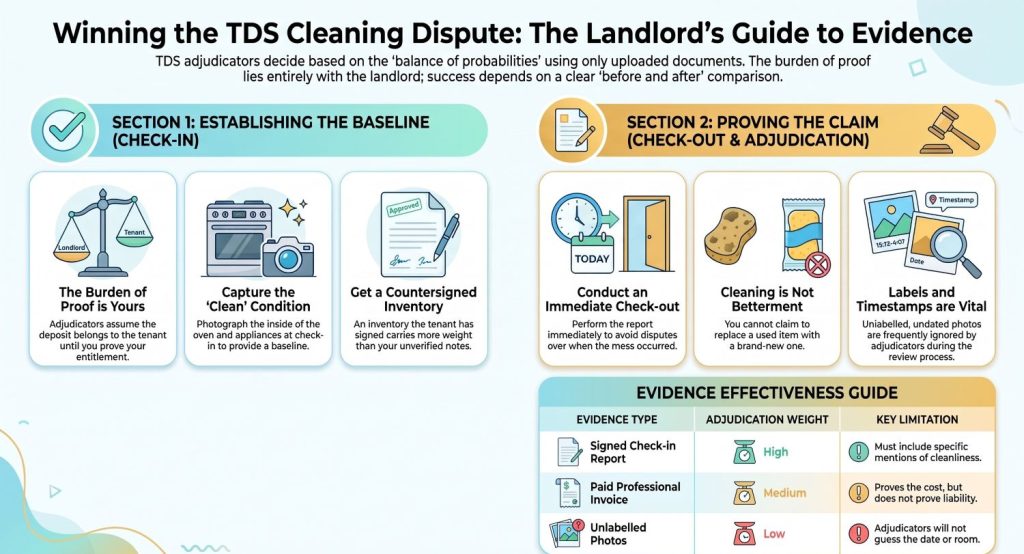
What Evidence Do Landlords Need to Win a Cleaning Deduction at TDS Adjudication

Here’s the uncomfortable part nobody tells landlords until it’s too late. When a cleaning deduction goes to adjudication at the Tenancy Deposit Scheme, the adjudicator never sees the flat. No visit. No walk-through. No sniff of the carpet. A stranger sits at a desk somewhere with a folder of whatever you both bothered to upload, and decides your claim on the balance of probabilities. If the folder’s thin, you lose – and it doesn’t matter how filthy the place actually was.

Why does the burden fall entirely on the landlord?

Because it was never your money.

The deposit belongs to the tenant for the whole tenancy. You’re holding it, that’s all. When you want to keep a slice of it for cleaning, you’re the one making a claim against someone else’s property, and the person making a claim carries the burden of proof. TDS states it plainly: the burden is always on the landlord. Not shared. Not “well, they left it in a state, so they should prove otherwise.” Yours.

That single fact reorders everything. An adjudicator who finds thin evidence on both sides does not split the difference down the middle. They return the disputed money to the tenant, because you failed to prove your entitlement to it. Absence of evidence works against the landlord, always.

The money was never yours to keep

Around one percent of protected deposits reach formal adjudication – a tiny slice against the millions of deposits held across England – and the landlords who end up there mostly lose. Adjudicators aren’t soft on tenants. Those landlords just turn up with a grievance and a phone full of undated photos where documented evidence should be. The tenant did leave the oven in a state. The landlord still loses. Both things are true and only one of them is on paper.

What does a winning check-in inventory actually contain?

This is the whole game, and most landlords skip it.

A cleaning claim is a comparison. End condition set against start condition. If you can’t show where the property started, you’ve nothing to measure the mess against, and the adjudicator – who never saw the flat clean or dirty – has no baseline to work from. The check-in inventory is that baseline. Get it wrong and the rest of your evidence is just decoration hung around a hole.

A strong check-in inventory is dated and photographic, room by room. It records the condition of everything, with images that are clearly labelled and clearly timestamped. The tenant should have received a copy and had the chance to comment or sign. An inventory the tenant never saw is weaker than one they countersigned, because the countersigned version is agreed and the other one is just your word typed up neatly. An adjudicator knows the difference and weighs it accordingly.

Landlords who use an agent usually get an independent inventory clerk as standard, and it tells at adjudication – an independent report carries more weight than one written by the party who stands to gain from it. Plenty of London’s self-managing landlords skip that, especially across the converted Victorian terraces of Walthamstow and Leyton, where a lot of small landlords run one or two flats off their own phone and never think about a clerk until they’re losing money in front of one. You don’t strictly need a clerk. A self-made inventory can still win, if it’s genuinely thorough and the tenant signed it. What sinks these landlords is simpler than a missing clerk: a five-line inventory with two blurry photos and no mention of cleanliness anywhere, dressed up as a record.

Then the part everyone forgets. Since the Tenant Fees Act 2019 you can’t force a tenant to pay for professional cleaning as a blanket condition of the tenancy. What you can require is that they return the property to the same standard of cleanliness it was let in. That standard is only enforceable if you recorded it. “Kitchen: good order” tells an adjudicator nothing about cleanliness. Was the oven degreased? Were the windows done? Was the flat professionally cleaned before this tenant moved in, with a receipt to prove it? If your check-in doesn’t say, the tenant’s obligation has no fixed point to return to, and your cleaning claim floats off into an argument you can’t win on paper.

I did a check-out last winter on a two-bed above a launderette on the High Road end of Leytonstone. The oven was genuinely grim – baked-on grease, two years of Sunday roasts, the tenant hadn’t touched it. The landlord was furious, and fair enough. He claimed £180. But his check-in inventory, which he’d done himself on his phone eighteen months earlier, read “kitchen – clean and tidy” alongside one wide photo that didn’t show the inside of the oven at all. No receipt for a professional clean at the start either. So the adjudicator had the tenant’s line that the oven “was already dirty when I moved in” set against a landlord’s photo that didn’t show the oven. You can guess where that lands. He got £40 towards the hob and worktops, which the tenant’s own check-out photos happened to show reasonably clean, and nothing for the oven. The oven was the entire reason he’d claimed. He lost it on a document he’d written himself.

The cleanliness baseline nobody records

Take one thing from a contractor who spends his weeks writing these reports: photograph the inside of the oven at check-in. Open the door and shoot the interior. Date it. The oven is the single most disputed item in an end-of-tenancy cleaning claim and it’s the one landlords never photograph at the start, because it was clean and nobody photographs clean things. A wide shot of a tidy kitchen is not evidence the oven was clean. The adjudicator won’t assume it for you. They assume nothing. They read paper.

Is a professional cleaning invoice worth anything on its own?

Here’s an opinion that annoys a fair few landlords: the cleaning invoice is the evidence you lean on hardest and it’s the one that proves the least.

Landlords wave the receipt about as though it settles the matter. It doesn’t. A £180 invoice proves you spent £180. It doesn’t prove the property needed £180 of cleaning, or that the dirt was this tenant’s doing rather than fair wear and tear left to accumulate. Stripped of a check-in baseline, an invoice is a number with no story attached, and the adjudicator needs the story before the number means anything.

What the invoice does do is fix the amount once liability is established elsewhere. And it has to be the right sort of invoice. TDS wants claims that are reasonable and reasoned – a sum that reflects genuine cost, itemised so the adjudicator can follow it line by line. A paid invoice beats a quote every time, because a quote is what someone might charge and a paid invoice is what the work actually cost. Three hundred pounds to clean a studio flat off the Roman Road isn’t reasonable, and an adjudicator will trim it down regardless of what the receipt says. They carry a rough sense of what cleaning costs in London and price your claim against that sense, not against your invoice.

Cleaning is not replacement

There’s a hierarchy adjudicators apply, and landlords routinely overshoot it. Cleaning comes first. Replacement is the last resort, allowed only when you can show cleaning was tried and failed.

A landlord once claimed the full cost of a replacement sofa over a stain. The tenant admitted causing it. The landlord still didn’t get the sofa, because there was no evidence anyone had attempted to clean it first – and a stained sofa that might come clean is not a written-off sofa. The same logic runs through every carpet and every mattress in the place. If you’re claiming to replace, prove the cleaning failed, in writing, ideally from a professional cleaner who tried. If you’re claiming to clean, claim the cleaning and stop there. Betterment – ending up with something better than you started with – gets struck out on sight, and asking for a new item to replace a five-year-old one is betterment with a bow on it.

How do you capture check-out evidence the adjudicator can use?

Speed and labels. Landlords still get both wrong.

Do the check-out report at the end of the tenancy, not a fortnight later. A check-out carried out ten days after the tenant handed back the keys invites the obvious question – who was in the property during those ten days, and might they have caused the mess? Timing that looks loose reads as loose. Then match every check-out observation to the matching check-in entry, so the change is visible item by item without anyone having to hunt for it. Nobody hunts. A photo dropped into a folder with no label and no room name gets skimmed straight past.

Dates, labels, and the photos that get ignored

Label the image “Kitchen – oven interior – [date]” and circle the grease if you must. An adjudicator working through forty photographs across two tenancies is not going to puzzle out which flat and which tenancy your unlabelled close-up of a stain belongs to. Make it impossible to misread. Number the check-out entries to match the check-in, so item four on one page is item four on the other, and the change reads itself. And keep every email where the tenant agreed to a deduction or went quiet after you raised one – silence, in this process, tends to be read as acceptance.

The tenant left the oven filthy in Leytonstone. Everyone knew it. The folder didn’t, so the adjudicator didn’t, and forty pounds is what a grievance is worth without a photograph of a clean oven taken eighteen months before anyone thought they’d need it.

top feature image

Mattress Cleaning at the End of a Tenancy: Who Is Responsible and What to Do

The mattress is the item nobody photographs at check-in. Sofas get photographed. Carpets get walked over with a clipboard and a frown. The mattress gets a glance, a line that reads “double mattress, fair condition”, and then eleven months of somebody sleeping on it before anyone gives it another thought. Then the check-out clerk arrives, lifts the corner, and there’s suddenly a conversation about your deposit.

Who is actually responsible for the mattress?

It depends entirely on whose mattress it is, and most tenancy disputes start with people forgetting that.

If you brought your own mattress into an unfurnished let – and a lot of London’s one-bed and studio stock goes out unfurnished now, particularly the newer build-to-rent blocks around Wembley Park and Nine Elms – the landlord has no claim on it at all. It’s your property. You can hand it to the council bulky-waste collection or drag it down to a skip. Nobody adjudicates the condition of your own belongings.

The furnished let is where it gets interesting. Here the mattress belongs to the landlord, it was listed on the check-in inventory, and you are on the hook to return it in the condition you received it – allowing for fair wear and tear. That last clause carries almost the entire weight of the argument. I’ll come back to it, because it’s where the maths lives.

What the Tenant Fees Act 2019 changed

Before June 2019 a landlord could write “property to be professionally cleaned on departure, receipts required” into the tenancy agreement and enforce it as a condition. That’s gone. Since the Tenant Fees Act came in, a landlord in England cannot make professional cleaning a mandatory term of the tenancy and cannot charge you a flat cleaning fee for the privilege.

What they can still do is deduct from your deposit for genuine dirtiness or damage that goes beyond the check-in state – and prove it. The mattress falls squarely under that. A landlord cannot bill you for a cleaner turning up on principle. They can bill you if you’ve left a stain that wasn’t there when you moved in, and they can evidence both ends of that. Different thing entirely.

What counts as fair wear and tear on a mattress?

A mattress ages whether you sleep well or badly on it. The springs settle. A body-shaped dip forms on your side. The ticking greys a little from ordinary use, and the whole thing loses a bit of loft. None of that is your fault and none of it is chargeable. An adjudicator expects a three-year-old mattress to look three years old, and gets suspicious of a landlord who claims otherwise.

Damage sits in a separate box. Damage is the stuff that arrives with an event, not with time.

The stains that actually trigger a deduction

Urine is the big one – a child, a pet, a bad night. It soaks through the ticking into the foam and it does not come out with a wipe and a hopeful expression. Blood behaves the same way. Heavy sweat yellowing is the grey area that goes to argument more often than people expect, because the landlord calls it staining and the tenant calls it age, and honestly the truth is usually sitting somewhere in the middle where nobody wants it. Mould is the one that turns properly nasty, and it often isn’t even the tenant’s doing. Picture a mattress shoved flat against a cold external wall in a Victorian conversion up in Crouch End, no airflow underneath the frame, single glazing sweating all winter. By March there’s black spotting on the underside. Whose fault that is depends entirely on whether the tenant reported the damp in writing. They usually didn’t. Write it down.

How do deposit schemes actually settle a mattress dispute?

This is the part that matters, and it’s the part nobody reads until they’re already arguing over ninety pounds by email.

Your deposit sits with one of three schemes – the TDS, the DPS, or mydeposits. If you and the landlord can’t agree a deduction, it goes to that scheme’s adjudicator, who looks at the check-in inventory, the check-out report, the photographs and the receipts, then makes a call. The adjudicator was not at the property. The adjudicator does not care about your account or the landlord’s account. The adjudicator cares about documented evidence and about one principle that decides nearly every mattress claim there is: betterment.

Betterment means a landlord cannot walk away better off than they started. If a mattress was five years old and stained beyond use, the landlord is owed the value of a five-year-old mattress – not the price of the shiny new one they’re actually going to order. And here is where the maths turns hard against the landlord almost every single time.

A mattress carries an accepted lifespan of roughly seven to eight years for adjudication purposes. Take a decent double that cost the landlord £400 new. Depreciate it across seven years and it sheds something like £57 of value a year. By year five it’s carrying around £115 of residual worth. So the absolute ceiling an adjudicator will award for a wrecked five-year-old mattress is about that £115 – and only if the check-in inventory proves it was pristine on day one, which it rarely does, because the check-in note said “double mattress, fair condition” and fair condition is not pristine. That vagueness costs landlords far more claims than tenants ever realise.

Now weigh that against a professional mattress clean, which runs somewhere between £40 and £70 across London depending on the borough and whether it’s rolled into a full end-of-tenancy job. You can see the problem forming. You might spend £60 cleaning a mattress to head off a £115 deduction that the landlord probably can’t fully evidence in the first place.

Here’s my actual position, and a fair few people in this trade will tell you I’m wrong: the mattress is the one item at the end of a tenancy where paying for a professional clean is usually a poor bet. Carpets, yes – a proper hot water extraction on the carpets genuinely shifts the check-out outcome, because carpet depreciation runs over a longer cycle and adjudicators take visible carpet grime seriously. The mattress doesn’t reward the spend the same way. The depreciation curve is simply too steep. Nine times out of ten you’d be scrubbing an item the landlord can barely claim against.

I did a check-out last year on a two-bed in one of the ex-council blocks off Frampton Park Road in Hackney. The tenant had done the sensible thing and put a £30 topper over the landlord’s mattress from her first night. Except the topper had wicked a spilt flat white straight through into the mattress below, one brown halo about the size of a dinner plate. She’d already paid a company ninety quid to steam it before I even got there. The stain was still faintly visible – coffee tannin in foam is stubborn stuff – and the mattress was six years old going by the check-in date. The landlord claimed £250. The adjudicator gave him £48. She’d spent ninety pounds to fend off a two-hundred-pound claim that collapsed to forty-eight on age alone. The clean changed nothing. The topper, the thing she’d bought for thirty quid and completely forgotten about, was the only part of that whole saga that actually protected her.

Betterment, and why the age of the mattress decides everything

Ask one question before you spend a penny. How old is the mattress? If the check-in inventory or the tenancy start date tells you it’s six, seven, eight years old, the landlord’s claim is already depreciated down to loose change and no amount of cleaning shifts the calculation an inch. If it’s genuinely new – a first tenancy in a freshly furnished flat, mattress barely a year old – then the maths flips, the potential deduction is large, and cleaning or even a quiet like-for-like replacement starts to make real sense. Age first. Everything else second.

What should you do before the check-out inventory?

Find the check-in inventory before you do anything else at all. Not the tenancy agreement – the inventory, the document with the photographs and the condition notes and hopefully a timestamp. If there was never a proper check-in inventory, the landlord has almost nothing to prove the mattress was clean when you arrived, and that gap quietly works in your favour throughout the whole process.

Then air the mattress properly. Strip it, stand it up, photograph every side in daylight with the date showing on the image. If there’s a light mark, spot-clean it with a little upholstery cleaner and cold water, blotting the fabric, never soaking it – a soaked mattress grows mould from the inside out and you’ve turned a small problem into an expensive one. Don’t flip a stained mattress to hide the mark underneath either. Check-out clerks lift mattresses as a matter of routine. They’ve seen that particular trick a thousand times over.

When professional cleaning is worth it – and when it isn’t

Worth it: a young mattress, under three years old, with a real and recent stain, where a credible claim of two or three hundred pounds is genuinely in play and the check-in proves the thing started clean. Pay the £60. It’s a sound bet and you’ll likely make it back.

Not worth it: anything over about five years old, or anything where the check-in note is vague and the landlord has no clean before-photograph to lean on. Save your money for the carpets, which is where the deduction fight is actually won and lost in most London flats. Document the mattress, hand it back, and let the depreciation do the work you were about to pay a cleaner to do.

The topper, for what it’s worth, is the cheapest insurance in the entire flat. Thirty pounds, fitted from the first night, machine-washable, and it takes the stain in place of the mattress underneath. Every tenant in a furnished London let should own one from day one. Most of them find out it exists at the check-out, which is exactly too late.

What Professional Cleaners Wish Tenants Knew About End of Tenancy Cleaning

If I got a quid for every time I interact with a clueless tenant who needs emergency help with their move-out cleaning, I could probably take my wife on the Caribbean cruise she has been nagging me about for years!

This guide clarifies what end of tenancy cleaning includes and why it is crucial for everyone involved. It addresses common misconceptions, shares tips from professional cleaners, and provides essential steps to prepare for the cleaning process.

Understanding End of Tenancy Cleaning

Understanding end of tenancy cleaning is extremely important for you, whether you’re a tenant or a landlord. It ensures the property is left spotless and meets the obligations outlined in the tenancy agreement.

This type of cleaning usually involves knowledgeable, professional cleaners who ensure every nook and cranny is up to the expected standards. As a tenant, it’s essential to understand your responsibilities if you want your deposit back.

For landlords, setting clear expectations can help avoid disputes when it’s time for property inspections.

Why Do Landlords Insist So Much On The Move-out Cleaning?

End of tenancy cleaning, or as you might call it, move-out cleaning, is all about giving that rental property a deep clean when you’re on your way out. It’s your chance to ensure the place meets the cleanliness standards landlords expect for the next fortunate tenants.

This process often involves hiring professional cleaners who know all the tricks to tackle those often-overlooked spots, such as behind appliances and inside cupboards. They come equipped with specialised cleaning products and tools—think steam cleaners and eco-friendly detergents—to tackle stubborn stains and grime like experts.

You’ll want to pay attention to the details here because every surface, from carpets to windows, requires special care. These cleaners have undergone professional training that equips them with the best practices to achieve that spotless finish. This keeps landlords happy and makes the property shine for future tenants.

The Importance of End of Tenancy Cleaning

One cannot underestimate the importance of end of tenancy cleaning. Tenants and landlords must meet their responsibilities and create a positive rental experience.

A good clean can significantly affect deposit returns and future rental opportunities.

Why it Matters for Tenants and Landlords

Understanding why end of tenancy cleaning is important for both tenants and landlords is key to building good relationships and avoiding conflicts. It sets the stage for clear communication and helps everyone adhere to property management expectations.

When you and your landlord both see the value in keeping things clean at the end of a tenancy, it protects your rights as a tenant and meets the landlord’s expectations for maintaining the property’s value. This shared understanding can help prevent the misunderstandings that often arise during the transition period.

Furthermore, implementing cleaning guarantees can boost satisfaction, giving you peace of mind about your deposit while encouraging landlords to maintain their properties to a high standard.

Ultimately, being open about cleaning practices makes both sides feel valued and understood. This paves the way for smoother transactions and better property management overall.

Common Misconceptions about End of Tenancy Cleaning

Common misconceptions about end of tenancy cleaning can throw a spanner in the works. It often leads to confusion and conflicts, especially when tenants and landlords have different views on what “clean” means and what standards are expected to return a property to its original condition.

Debunking Myths and Clarifying Expectations

Debunking myths and setting clear expectations around end of tenancy cleaning take the weight off your shoulders, whether you’re a tenant or a landlord. It helps ensure everyone is on the same page about accountability and effective cleaning that meets industry standards.

You might think a quick surface clean will do the trick, but let’s be honest—landlords usually expect a deep clean that tackles every nook and cranny. You must realise that skipping spots like behind appliances or inside cupboards can lead to disputes over your tenancy deposit.

Feedback from previous renters shows that investing in professional cleaning services is often a sensible move. These experts know the specific requirements for different properties, both inside and out.

By agreeing on what’s expected, you and your landlord can make the end of your tenancy much smoother for everyone involved.

What Professional Cleaners Want Tenants to Know

Professional cleaners want you to know that the success of your end of tenancy cleaning depends on a few key things: preparation, communication, and understanding your responsibilities as a tenant.

When you get these elements right, it makes for a smooth transition for everyone involved.

Insider Tips and Advice for a Successful Cleaning

For a successful end of tenancy cleaning, you’ll want to keep a few insider tips in mind: create a detailed cleaning schedule, manage your time wisely, and ensure all your cleaning documentation is in order before that final walkthrough with your landlord.

By breaking your cleaning tasks into pre-cleaning and post-cleaning categories, you can easily track what you’ve accomplished and what still needs attention. Start by decluttering all your spaces and gathering the necessary supplies, such as cleaners and tools, before diving into the actual cleaning.

Once you’ve tackled the deep clean, don’t forget to do a thorough walkthrough. Document any improvements you’ve made and discuss any areas of concern with your landlord. This keeps things transparent and helps resolve potential disputes, ensuring that both you and your landlord are satisfied with the property’s condition.

Preparing for End of Tenancy Cleaning

Preparing for end of tenancy cleaning requires a bit of organisation on your part. You’ll want to follow a clear cleaning checklist to ensure you meet your responsibilities and leave the property in a condition your landlord will approve of.

Steps to Take Before the Cleaners Arrive

Before the cleaners arrive, you should take a few steps to ensure everything goes smoothly. Gather the necessary cleaning supplies, do some basic dusting and vacuuming, and inform the cleaning service about any special requests you may have.

Taking a little time to prepare enhances the effectiveness of the cleaning service, leading to a fresher and more organised space for you. Gathering supplies like all-purpose cleaners, microfibre cloths, and refuse bags is a sensible move. Having these ready can help the cleaners do a more thorough job.

Clearing off surfaces and decluttering can create space for them to work their magic. Additionally, being open and proactive about your specific needs or areas of concern helps avoid misunderstandings and builds trust. This way, the cleaners can perform their job with a clear understanding of what you expect.

Choosing a Professional Cleaning Service

Choosing a professional cleaning service is significant for you as a tenant. It’s all about ensuring your end of tenancy cleaning meets the right standards.

Finding trustworthy service providers can truly make a world of difference in keeping you happy and retrieving your deposit.

Factors to Consider and Questions to Ask

When choosing a professional cleaning service, it’s crucial to consider a few key factors and ask the right questions. You can request cleaning quotes, check how flexible their scheduling is, and see if they adhere to the cleaning standards you expect.

You’ll also want to explore their range of services, ask about the environmentally friendly products they use, and ensure the cleaners are fully insured and bonded. Investigating these details will help you assess the reliability and quality of the service, which can enhance customer loyalty and improve your overall cleaning experience.

Remember to discuss any specific cleaning needs or preferences right from the start. This will encourage open communication and establish a foundation of trust, paving the way for a long-lasting relationship with your cleaning service.

Back-to-School Cleaning: Getting Your Home Ready

As the back-to-school season rolls in, it’s the perfect time to transform your home into a tidy, organised space that boosts focus and productivity.

This guide is here to help you create a solid cleaning plan, declutter your space, and streamline your living areas.

You’ll find deep cleaning strategies to make your home feel fresh and inviting, a list of essential supplies you’ll need, and practical tips for keeping things clean throughout the school year.

And don’t worry—there are ways to get the whole family involved in this refreshing effort. Get ready to reclaim your home and set the stage for a successful school year!

Preparing for Back-to-School Cleaning

As the school year approaches, it’s the perfect time to embark on a back-to-school cleaning journey to set you and your family up for success. This isn’t just about a quick tidy-up; it’s about giving your living spaces a thorough clean and some organisation to create an environment about productivity and learning.

By preparing your home with effective cleaning routines and involving the whole family, you can streamline household tasks and create a more efficient atmosphere for everyone. With checklists, you can easily tackle clutter and ensure your home is ready for the busy school year ahead.

Tips for Streamlining Your Home

Creating a Cleaning Plan

Creating a cleaning plan is crucial for streamlining your back-to-school cleaning efforts, ensuring every area of your home receives the attention it deserves. Setting up a structured schedule and dividing tasks among family members can boost productivity and keep things tidy as you prepare for the new school year. Ensure your plan includes specific cleaning checklists for different areas so you can focus on what matters and maintain a clutter-free home that meets your family’s needs.

To devise an effective cleaning plan, involve everyone from the start. This helps everyone feel invested and builds teamwork within the household. Begin by making labelled checklists for various tasks and assigning specific areas to each person based on age and abilities. Having a regular cleaning schedule means everyone remains accountable, plus it takes the dread out of the cleaning process.

Remember, consistency is key! A few minutes of tidying up each day can lighten the load. And don’t forget to keep the lines of communication open about what’s working and what needs adjusting. This way, you create a genuine team effort plan, with everyone contributing.

Organising and Decluttering

Organising and decluttering your home is crucial as you prepare for the back-to-school season. It sets the stage for a fresh start for your family.

This process isn’t just about removing old and unnecessary items; it’s also a chance to make your living spaces work better for you and feel more comfortable.

By embracing minimalism and simplicity, you can create smart storage solutions that keep the clutter at bay. This is extremely important for fostering effective study habits and reducing stress once the school year begins.

Tips for Streamlining Your Home

To streamline your home effectively, consider implementing practical tips that boost organisation and get the whole family involved in the cleaning process. Using specific organisation tools and clever cleaning hacks enhances your efficiency, allowing you to focus on the essential tasks that create a healthier and more inviting home. Simple tweaks like setting up designated homework spaces and clutter-free zones can significantly foster a productive atmosphere for your children as they enter their school routines.

Establishing a consistent tidying schedule, getting family members on board with the organisation’s efforts, and using storage bins for easy access are all critical strategies for keeping your space in order. Encouraging your children to take responsibility for their belongings helps nurture valuable habits while promoting teamwork and strengthening those family bonds.

Don’t underestimate the power of labelling storage areas—this can save you time and reduce frustration, making it much easier for everyone to find what they need.

These organisational strategies can do wonders for decluttering your home and creating an environment that fosters focus and creativity, boosting your child’s academic efforts.

Deep Cleaning for a Fresh Start

Deep home cleaning is crucial to a fresh start before the school year begins. You want to ensure all surfaces are sanitised and ready for daily life.

This isn’t just about a quick tidy-up; it’s about tackling dust, allergens, and germs that can accumulate in your space and impact your family’s health and hygiene.

Paying attention to areas like windows, carpets, and cleaning supplies can create a healthy environment that promotes comfort and productivity as your children return to school.

Areas to Focus On

When deep cleaning your home, it’s imperative to identify the key areas that need extra care, especially your children’s spaces and study zones. Focusing on high-traffic areas like utility rooms, homework spots, and classrooms can boost your home’s cleanliness and organisation.

By ensuring these areas are sanitised and clutter-free, you not only create a healthier living space but also help foster better study habits and mental clarity for the school year.

Take a moment to pay attention to surfaces like desks, play areas, and those kitchen countertops you use every day. Dusting, disinfecting, and organising these spots can completely transform your daily routines. Creating an atmosphere that minimises distractions will support learning and make life smoother.

The benefits go beyond how things appear; keeping your environment tidy and clean contributes to the overall well-being of everyone in the family, leading to better focus and productivity.

Therefore, spending some time on deep cleaning can genuinely turn your home into a place that inspires creativity, learning, and good health.

Strategies for Staying Organized and Tidy

Cleaning Supplies and Tools You’ll Need

The right cleaning supplies and tools are essential for effective back-to-school cleaning. They ensure that you’re ready to tackle any mess that comes your way.

Investing in eco-friendly cleaning products helps create a healthy home environment and aligns with modern cleaning practices that focus on safety and sustainability.

Having a well-stocked supply of everything from organisational tools to essential cleaning equipment can make cleaning smoother and more enjoyable for the whole family.

Essential Products and Equipment

Essential cleaning products and equipment can change the game when you prepare your home for the school year. They help you keep your space tidy without breaking a sweat. From high-quality cleaning tools to eco-friendly supplies, the right equipment can make your cleaning routine a breeze and boost the overall vibe of your home.

Investing in multi-purpose cleaners and organisational products will save time and ensure your family’s health and safety are top priorities during the cleaning process.

These items are crucial to making cleaning more efficient and promoting sustainability. Think about adding biodegradable all-purpose cleaners that tackle dirt effectively without harmful chemicals. Pair those with microfibre cloths that reduce waste while delivering serious cleaning power. Using a vacuum cleaner with a HEPA filter can help capture allergens and improve the air quality inside your home.

Organising bins and caddies will help you declutter and make it easier to find what you need when you need it. By incorporating these eco-friendly cleaning products and organised systems, you will create a harmonious and healthy environment in your home, making those back-to-school preparations much smoother for everyone.

Maintaining a Clean Home During the School Year

Maintaining a clean home during the school year means setting effective routines and adapting to your family’s schedule, ensuring cleanliness remains a priority even on hectic days.

By incorporating simple cleaning habits into your daily routines and involving the whole family, you can create a supportive environment that enhances productivity and keeps clutter at bay.

Additionally, using some time management techniques and productivity strategies can help everyone stay organised and focused, making it easier to tackle homework and household chores together.

Strategies for Staying Organised and Tidy

Implementing effective strategies to stay organised and tidy boosts your family’s experience during the school year, making daily tasks easier for everyone. By setting up routines for the children and assigning specific roles in the cleaning process, you can build a sense of accountability and teamwork that encourages everyone to pitch in and keep the home clean.

Simple things like creating designated homework spaces and having regular decluttering sessions help establish positive habits that last throughout the school year.

Incorporating family cleaning days into your weekly schedule lets everyone chip in, making the whole cleaning process feel less overwhelming. Assigning specific responsibilities—like tidying up shared areas or organising personal belongings—creates a collaborative vibe everyone can get behind.

To keep the energy up, consider a reward system to celebrate the children’s efforts in maintaining their own spaces. This shared commitment teaches valuable organisational skills and reinforces that keeping a tidy home is a team effort, which can keep motivation high all year.

Involving the Whole Family in Cleaning

Getting the whole family involved in cleaning makes the process more efficient, helps build teamwork, and strengthens family bonds. Assigning specific roles and tasks can encourage a sense of responsibility and cooperation, turning cleaning into a shared effort instead of merely a chore.

This way, those cleaning sessions can become quality family time, instilling positive habits and allowing everyone to contribute to keeping the home tidy.

Assigning Tasks and Making it a Team Effort

Assigning tasks and making cleaning a team effort is a great way to get your family involved and boost everyone’s motivation. Clearly defining roles and responsibilities promotes accountability and makes cleaning more efficient. This lightens the load for each family member and creates a collaborative atmosphere, encouraging everyone to pitch in and take pride in your shared space.

Regular family meetings to discuss upcoming cleaning schedules help everyone feel like they belong and have a stake in the project. This helps balance tasks based on each person’s strengths and builds camaraderie as everyone works together towards those cleanliness goals.

By brainstorming ideas, your family can devise creative ways to make cleaning feel less like a chore and more like a fun challenge. Ultimately, this streamlines your cleaning routine and fosters a supportive environment where everyone feels motivated and appreciated for their contributions.

Professional Tips To Optimise Your Moveout Task Sheet – It Is All About Efficiency

If you’re about to move out from your London rented property and want to simplify the move-out process, you must grasp the significance of having a move-out task sheet. It’s critical for boosting efficiency and steering clear of those pesky pitfalls. In this article, we’ll show you why having a move-out task sheet is a must, essential elements to include when making one, tricks for fine-tuning your sheet, blunders to dodge, and ways to leverage technology for smoother move-out tasks.

Look for expert advice on how to improve your move-out task sheet—it’s all about ramping up efficiency!

Understanding the Importance of a Move-out Task Sheet

Having a move-out task sheet is vital when you’re getting ready for a move. It’s like your trusty roadmap, guiding you through organising, prioritising, and streamlining the moving process smoothly.

Why is a Move-out Task Sheet Necessary?

When you’re gearing up to move, having a task sheet is vital for keeping things on track. It’s like your moving GPS, helping you manage your time, stay organised, and ensure you don’t miss any crucial steps.

With a list of tasks in hand, you can tackle your moving to-dos smartly. Start with the big stuff first to make sure you’re covering all your bases efficiently. This not only saves you time but also helps keep stress levels down as you work through everything step by step. Your task sheet is like a road map, showing you where you’ve been and where you’re headed next.

Remember to incorporate some decluttering strategies as you go. This will make packing up a breeze and help you get rid of stuff you don’t need so your new place feels fresh and organised from day one.

Creating an Efficient Move-out Task Sheet

When you’re ready to move out, you want to assemble a solid move-out task sheet. This means planning everything carefully, packing strategically, labelling things clearly, and coordinating logistics like a pro. Your task sheet is basically the blueprint for a smooth and hassle-free move.

Key Elements and Considerations

When putting together a move-out task sheet that actually works, you’ve got to think about some key things. First, make sure you prioritise your tasks, create a solid schedule, and follow the best practices for a smooth transition.

Paying attention to task prioritisation is a game-changer. It helps you focus on the most important stuff first, making sure you knock out those essential tasks on time. Having a detailed schedule in place is critical, too. It gives you enough time for each task so you don’t overlook anything or run behind schedule. And don’t forget to stick to those best practices like labelling your boxes properlypacking smart, and coordinating with the movers. Doing things the right way can really streamline the whole moving process and keep your stress levels in check. Just organise your tasks logically, set realistic deadlines, and don’t hesitate to ask for help when you need it. That way, you’ll make a successful move with efficiency and precision.

Tips for Optimising Your Move-out Task Sheet

When optimising your move-out task sheet, you want to focus on:

  • Streamlining the process
  • Clear communication
  • Involve family members, close friends, and relatives to help.

Streamlining the Process

Streamlining your move-out process involves a few key steps:

  1. Clean thoroughly
  2. Ask for feedback
  3. Keep optimising to make sure your relocation goes off without a hitch.

To make your move-out as seamless as possible:

  1. Start by decluttering and organising your space like a pro.
  2. Focus on giving high-traffic spots, such as kitchens and bathrooms, a deep clean to really impress.
  3. Use eco-friendly cleaning products to keep things green and ensure your home shines bright.
  4. Consider using digital feedback tools or surveys to get valuable insights on areas that need a little boost.
  5. Take those suggestions to heart, making regular tweaks to improve your process and make your move-out smoother and more efficient overall.

Maximising Efficiency

To maximise efficiency during your move-out, you must maximise logistic support, go for budget-friendly options, and use cost-effective strategies for a smooth relocation. Hiring professional movers can be a game-changer. They’ll handle packing and transporting your stuff like pros, saving you precious time and energy.

While it may seem like a splurge upfront, investing in top-notch packing materials can save you money in the long run by preventing damages and the need for replacements. Consider planning your move during off-peak or weekdays to optimise your budget without sacrificing quality. This can score lower rates from moving companies, helping you save some cash while still getting top-notch service.

Common Mistakes to Avoid

When you’re moving out, avoid common mistakes by being proactive, keeping your inventory in check, and breaking down your furniture properly. This will avoid any logistical headaches and ensure your move goes off without a hitch.

Pitfalls to Watch Out For

When you’re moving, be on the lookout for pitfalls like unpacking in a rushtaking forever to settle into your new place, and forgetting to notify your landlord about deadlines and schedules. Those things can throw a spanner into your whole moving experience.

To avoid unpacking nightmares, try using smart unpacking strategies. Label boxes, organise things by room, and create a list of must-unpack items to tackle first.

Plan your transition carefully to avoid settling in snags. Get your utilities up and running, arrange your furniture according to the floor plan, and ensure all your essential services are ready.

Utilising Technology for Move-out Tasks

When you use technology for your move-out tasks, it enhances your performance. You’ll breeze through tasks, handle everything like a professional, and ensure you’re environmentally friendly.

The Top Seven Questions To Ask A Contractor Before Booking It For Your End Of Tenancy Cleaning

If you’re moving out of a rental property, you may have heard about the importance of end of tenancy cleaning. What you may not recognise are the pitfalls of choosing an inadequate cleaning contractor or approaching the selection process from the wrong angle. So, today, we look at the seven most important questions you should ask a tenancy cleaning contractor before you book them for the job. 

What is End of Tenancy Cleaning?

End of tenancy cleaning is essential when moving out of a rental property. It involves thoroughly cleaning the entire property, including all rooms, bathrooms, kitchen, and common areas. The purpose of this cleaning is to ensure that the property is left in pristine condition for the next tenant.

A comprehensive cleaning checklist covers dusting, vacuuming, mopping floors, cleaning appliances, and sanitising surfaces. The benefits of end of tenancy cleaning include avoiding disputes with landlords over the return of your security deposit and leaving a positive impression for future references.

Hiring professional cleaning services for this task is crucial as they have the expertise, equipment, and knowledge of the cleaning process specific to different property types.

What Does an End of Tenancy Cleaning Service Include?

An end of tenancy cleaning service typically covers a thorough cleaning of all rooms, appliances, carpets, windows, and bathrooms and kitchens.

Professional end of tenancy cleaners utilise specialised cleaning supplies to achieve impeccable results. Dusting ceilings, walls, and skirting boards, vacuuming carpets and upholstery, and sanitising bathrooms are vital. These professionals pay attention to detail, ensuring high-quality standards are met.

The cleaning process often includes deep cleaning kitchen appliances and eliminating built-up grime or grease. From scrubbing floors to disinfecting surfaces, every corner of the property receives meticulous care as part of the service.

What Should I Look for in an End of Tenancy Cleaning Contractor?

When selecting an end of tenancy cleaning contractor, it is crucial to consider factors such as experienceinsurance coverageavailability, and customer reviews.

References from previous clients can offer valuable insights into the quality of service provided. A reputable contractor should be able to provide references upon request, showcasing their track record of satisfied customers.

A thorough initial inspection of the property is essential to accurately assess the scope of work and provide an accurate quote.

Clear communication channels, outlined in a detailed service agreement, are paramount to ensure that both parties are on the same page regarding expectations and obligations.

A reliable service guarantee can also provide peace of mind, knowing that any issues post-cleaning will be addressed promptly.

Experience and Reputation

The experience and reputation of an end of tenancy cleaning contractor are vital to evaluate, ensuring the delivery of professional services and quality standards.

An experienced and well-reputed contractor possesses the necessary skills and knowledge and understands the industry standards that govern end-of-tenancy cleaning. Their ability to meet these standards ensures that customers receive satisfactory results, reflected in positive feedback and high levels of customer satisfaction. Reputable cleaners use professional-grade equipment that guarantees a thorough and efficient cleaning process.

Seeking professional advice from established contractors can further enhance the overall end-of-tenancy cleaning experience for landlords and tenants.

Insurance and Bonding

Ensuring that an end of tenancy cleaning contractor has adequate insurance and bonding provides essential legal protection and coverage in case of unforeseen damages or incidents.

This insurance coverage guarantees that the client is safeguarded in the event of accidental damage or disputes over the quality of services provided. Bonding ensures that the contractor follows industry standards and regulations while offering services. Insurance and bonding provide peace of mind to both parties involved. It ensures that potential liabilities or damages are covered, establishing trust and professionalism at the end of the tenancy cleaning service industry.

Availability and Flexibility

The availability and flexibility of an end of tenancy cleaning contractor are crucial factors in ensuring the cleaning aligns with your schedule and timeframe.

When selecting a contractor, it’s essential to consider the type of property being cleaned. Different properties like flats, houses, or commercial spaces may have varying requirements and complexities.

The contractor’s availability should also accommodate any special requests you may have, such as deep cleaning certain areas or using specific cleaning supplies. Scheduling flexibility becomes even more vital when dealing with multiple properties or a tight timeframe, ensuring the cleaning is completed efficiently without compromising quality.

Customer Reviews and Testimonials

Customer reviews and testimonials offer valuable insights into the service quality and customer satisfaction levels provided by an end of tenancy cleaning contractor.

These reviews reflect previous customers’ experiences, shedding light on factors like the thoroughness of the cleaning process, punctuality, and overall professionalism of the contractor.

By reading through these testimonials, potential clients can gauge the level of customer support offered, which is crucial in ensuring a smooth and stress-free end of tenancy cleaning experience.

Positive reviews also signal credibility and reliability, instilling confidence in prospective clients regarding the contractor’s ability to deliver on promises.

It’s not just about the cleaning service itself; it’s also about the booking process, follow-up procedures, and how well the contractor addresses any concerns or queries.

What Questions Should I Ask a Contractor Before Booking?

Before booking an end of tenancy cleaning service, it is essential to ask specific questions to clarify service details, expectations, and terms.

It is essential to enquire about the service agreement, including what tasks are included in the cleaning, if any specialised equipment is needed, and the estimated duration for completion.

Understanding the payment terms, such as upfront costs, additional fees for extra services, and accepted payment methods, is also crucial.

Discussing the cleaning contractor’s safety measures, like using eco-friendly products or following COVID-19 protocols, can provide reassurance.

Confirming the cancellation policy and how communication will be maintained throughout the cleaning process is advisable.

What Services are Included in the End of Tenancy Cleaning?

Understanding the specific services included at an end of tenancy cleaning is essential to ensure all areas of the property are covered, often involving a detailed inspection.

  1. During the end of tenancy cleaning process, professional cleaners typically conduct a thorough inspection to identify areas requiring special attention, such as kitchens, bathrooms, and living spaces. They utilise high-quality cleaning supplies and specialised equipment to deliver a deep clean, ensuring that surfaces, appliances, and fixtures are left spotless.

A well-defined service agreement outlines the scope of work, timelines, and cost estimates, providing tenants and landlords transparency and peace of mind. Adherence to quality standards at the end of tenancy cleaning is crucial to meeting expectations and ensuring a smooth transition for all parties involved.

Do You Provide Your Cleaning Supplies?

Clarifying whether the end of tenancy cleaning contractor provides their cleaning supplies and equipment is crucial for seamless service delivery and quality standards.

Having the necessary equipment ensures that the cleaning process is efficient and thorough, meeting the high expectations of both landlords and tenants. Specialised tools such as steam and industrial vacuum cleaners can effectively tackle tough stains and grime. The provision of eco-friendly cleaning products underscores the commitment to sustainability and reduces the environmental impact of the cleaning process. Adherence to safety measures when handling equipment and using cleaning supplies minimises risks and protects the cleaners and the property being serviced.

How Long Will the Cleaning Take?

Understanding the estimated duration of the end of tenancy cleaning process is essential for planning and coordinating with property handover deadlines.

Factors such as the size of the property and the level of cleanliness required can significantly impact the overall timeframe for the cleaning service. Larger properties may need more time and resources to ensure thorough cleaning, while smaller spaces may be completed more quickly. Tenants and landlords must be mindful of the cleaning schedule to avoid delays in the handover process. Meeting the property deadline ensures a smooth transition between tenants and maintains a positive landlord-tenant relationship.

What is Your Cancellation Policy?

Clarifying the cancellation policy of an end of tenancy cleaning contractor is essential to understand the implications, terms, and conditions in case of unforeseen changes.

It ensures both parties a smooth and hassle-free process and provides legal protection for all involved. Discussing the cancellation policy upfront guarantees that both parties are on the same page regarding expectations and potential outcomes. Reviewing the terms and conditions related to cancellations, such as any required notice period or associated fees, is crucial. Being well-informed about the cancellation policy can help prevent misunderstandings and disputes, promoting a transparent and professional relationship with the cleaning contractor.