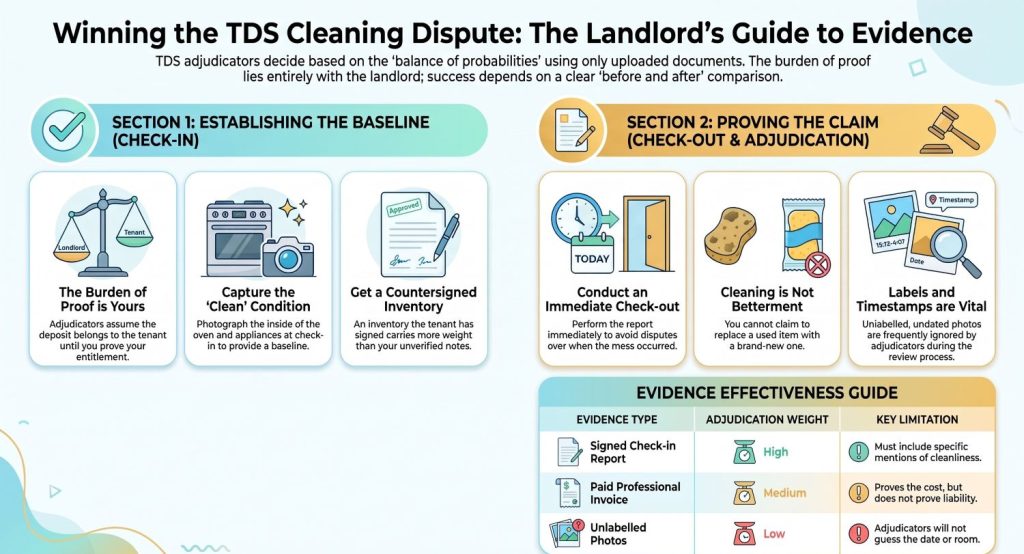
Here’s the uncomfortable part nobody tells landlords until it’s too late. When a cleaning deduction goes to adjudication at the Tenancy Deposit Scheme, the adjudicator never sees the flat. No visit. No walk-through. No sniff of the carpet. A stranger sits at a desk somewhere with a folder of whatever you both bothered to upload, and decides your claim on the balance of probabilities. If the folder’s thin, you lose – and it doesn’t matter how filthy the place actually was.
Why does the burden fall entirely on the landlord?
Because it was never your money.
The deposit belongs to the tenant for the whole tenancy. You’re holding it, that’s all. When you want to keep a slice of it for cleaning, you’re the one making a claim against someone else’s property, and the person making a claim carries the burden of proof. TDS states it plainly: the burden is always on the landlord. Not shared. Not “well, they left it in a state, so they should prove otherwise.” Yours.
That single fact reorders everything. An adjudicator who finds thin evidence on both sides does not split the difference down the middle. They return the disputed money to the tenant, because you failed to prove your entitlement to it. Absence of evidence works against the landlord, always.
The money was never yours to keep
Around one percent of protected deposits reach formal adjudication – a tiny slice against the millions of deposits held across England – and the landlords who end up there mostly lose. Adjudicators aren’t soft on tenants. Those landlords just turn up with a grievance and a phone full of undated photos where documented evidence should be. The tenant did leave the oven in a state. The landlord still loses. Both things are true and only one of them is on paper.
What does a winning check-in inventory actually contain?
This is the whole game, and most landlords skip it.
A cleaning claim is a comparison. End condition set against start condition. If you can’t show where the property started, you’ve nothing to measure the mess against, and the adjudicator – who never saw the flat clean or dirty – has no baseline to work from. The check-in inventory is that baseline. Get it wrong and the rest of your evidence is just decoration hung around a hole.
A strong check-in inventory is dated and photographic, room by room. It records the condition of everything, with images that are clearly labelled and clearly timestamped. The tenant should have received a copy and had the chance to comment or sign. An inventory the tenant never saw is weaker than one they countersigned, because the countersigned version is agreed and the other one is just your word typed up neatly. An adjudicator knows the difference and weighs it accordingly.
Landlords who use an agent usually get an independent inventory clerk as standard, and it tells at adjudication – an independent report carries more weight than one written by the party who stands to gain from it. Plenty of London’s self-managing landlords skip that, especially across the converted Victorian terraces of Walthamstow and Leyton, where a lot of small landlords run one or two flats off their own phone and never think about a clerk until they’re losing money in front of one. You don’t strictly need a clerk. A self-made inventory can still win, if it’s genuinely thorough and the tenant signed it. What sinks these landlords is simpler than a missing clerk: a five-line inventory with two blurry photos and no mention of cleanliness anywhere, dressed up as a record.
Then the part everyone forgets. Since the Tenant Fees Act 2019 you can’t force a tenant to pay for professional cleaning as a blanket condition of the tenancy. What you can require is that they return the property to the same standard of cleanliness it was let in. That standard is only enforceable if you recorded it. “Kitchen: good order” tells an adjudicator nothing about cleanliness. Was the oven degreased? Were the windows done? Was the flat professionally cleaned before this tenant moved in, with a receipt to prove it? If your check-in doesn’t say, the tenant’s obligation has no fixed point to return to, and your cleaning claim floats off into an argument you can’t win on paper.
I did a check-out last winter on a two-bed above a launderette on the High Road end of Leytonstone. The oven was genuinely grim – baked-on grease, two years of Sunday roasts, the tenant hadn’t touched it. The landlord was furious, and fair enough. He claimed £180. But his check-in inventory, which he’d done himself on his phone eighteen months earlier, read “kitchen – clean and tidy” alongside one wide photo that didn’t show the inside of the oven at all. No receipt for a professional clean at the start either. So the adjudicator had the tenant’s line that the oven “was already dirty when I moved in” set against a landlord’s photo that didn’t show the oven. You can guess where that lands. He got £40 towards the hob and worktops, which the tenant’s own check-out photos happened to show reasonably clean, and nothing for the oven. The oven was the entire reason he’d claimed. He lost it on a document he’d written himself.
The cleanliness baseline nobody records
Take one thing from a contractor who spends his weeks writing these reports: photograph the inside of the oven at check-in. Open the door and shoot the interior. Date it. The oven is the single most disputed item in an end-of-tenancy cleaning claim and it’s the one landlords never photograph at the start, because it was clean and nobody photographs clean things. A wide shot of a tidy kitchen is not evidence the oven was clean. The adjudicator won’t assume it for you. They assume nothing. They read paper.
Is a professional cleaning invoice worth anything on its own?
Here’s an opinion that annoys a fair few landlords: the cleaning invoice is the evidence you lean on hardest and it’s the one that proves the least.
Landlords wave the receipt about as though it settles the matter. It doesn’t. A £180 invoice proves you spent £180. It doesn’t prove the property needed £180 of cleaning, or that the dirt was this tenant’s doing rather than fair wear and tear left to accumulate. Stripped of a check-in baseline, an invoice is a number with no story attached, and the adjudicator needs the story before the number means anything.
What the invoice does do is fix the amount once liability is established elsewhere. And it has to be the right sort of invoice. TDS wants claims that are reasonable and reasoned – a sum that reflects genuine cost, itemised so the adjudicator can follow it line by line. A paid invoice beats a quote every time, because a quote is what someone might charge and a paid invoice is what the work actually cost. Three hundred pounds to clean a studio flat off the Roman Road isn’t reasonable, and an adjudicator will trim it down regardless of what the receipt says. They carry a rough sense of what cleaning costs in London and price your claim against that sense, not against your invoice.
Cleaning is not replacement
There’s a hierarchy adjudicators apply, and landlords routinely overshoot it. Cleaning comes first. Replacement is the last resort, allowed only when you can show cleaning was tried and failed.
A landlord once claimed the full cost of a replacement sofa over a stain. The tenant admitted causing it. The landlord still didn’t get the sofa, because there was no evidence anyone had attempted to clean it first – and a stained sofa that might come clean is not a written-off sofa. The same logic runs through every carpet and every mattress in the place. If you’re claiming to replace, prove the cleaning failed, in writing, ideally from a professional cleaner who tried. If you’re claiming to clean, claim the cleaning and stop there. Betterment – ending up with something better than you started with – gets struck out on sight, and asking for a new item to replace a five-year-old one is betterment with a bow on it.
How do you capture check-out evidence the adjudicator can use?
Speed and labels. Landlords still get both wrong.
Do the check-out report at the end of the tenancy, not a fortnight later. A check-out carried out ten days after the tenant handed back the keys invites the obvious question – who was in the property during those ten days, and might they have caused the mess? Timing that looks loose reads as loose. Then match every check-out observation to the matching check-in entry, so the change is visible item by item without anyone having to hunt for it. Nobody hunts. A photo dropped into a folder with no label and no room name gets skimmed straight past.
Dates, labels, and the photos that get ignored
Label the image “Kitchen – oven interior – [date]” and circle the grease if you must. An adjudicator working through forty photographs across two tenancies is not going to puzzle out which flat and which tenancy your unlabelled close-up of a stain belongs to. Make it impossible to misread. Number the check-out entries to match the check-in, so item four on one page is item four on the other, and the change reads itself. And keep every email where the tenant agreed to a deduction or went quiet after you raised one – silence, in this process, tends to be read as acceptance.
The tenant left the oven filthy in Leytonstone. Everyone knew it. The folder didn’t, so the adjudicator didn’t, and forty pounds is what a grievance is worth without a photograph of a clean oven taken eighteen months before anyone thought they’d need it.
Comments are closed.