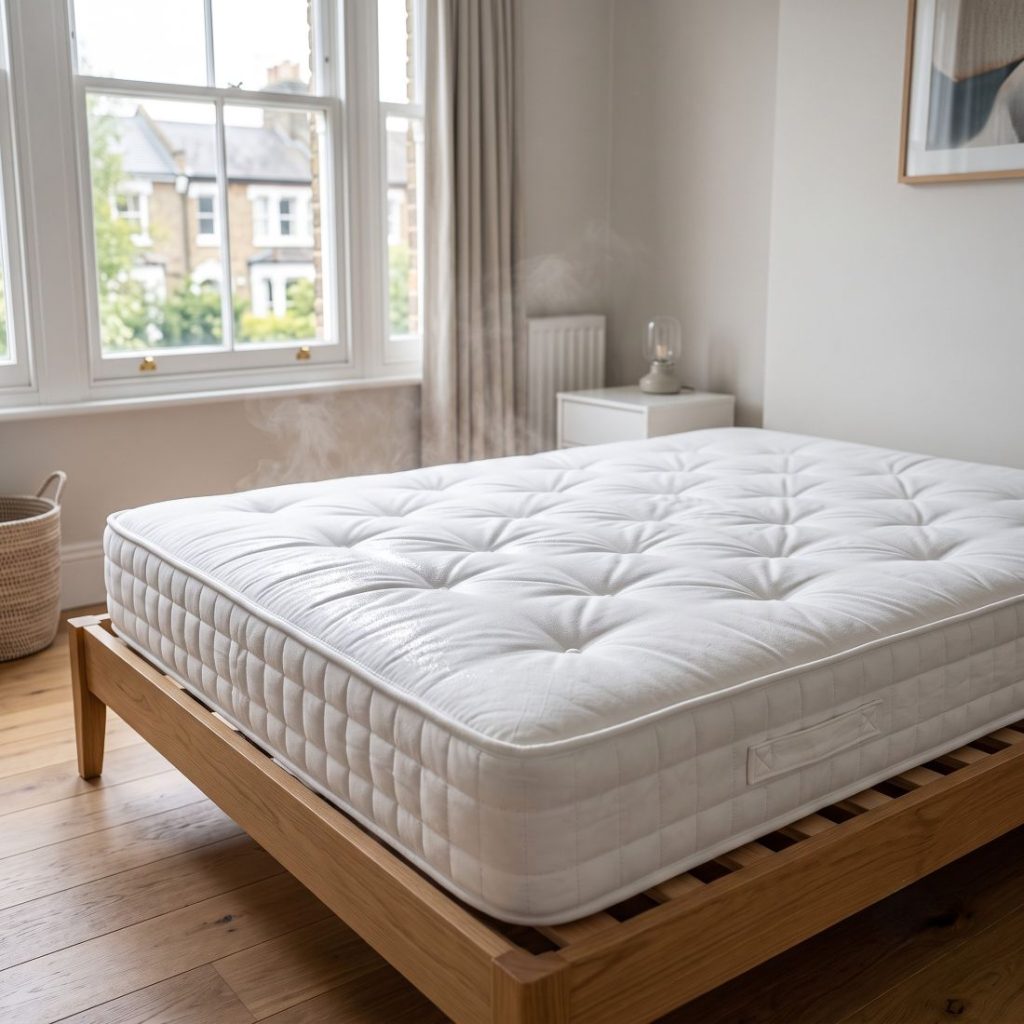
The mattress is the item nobody photographs at check-in. Sofas get photographed. Carpets get walked over with a clipboard and a frown. The mattress gets a glance, a line that reads “double mattress, fair condition”, and then eleven months of somebody sleeping on it before anyone gives it another thought. Then the check-out clerk arrives, lifts the corner, and there’s suddenly a conversation about your deposit.
Who is actually responsible for the mattress?
It depends entirely on whose mattress it is, and most tenancy disputes start with people forgetting that.
If you brought your own mattress into an unfurnished let – and a lot of London’s one-bed and studio stock goes out unfurnished now, particularly the newer build-to-rent blocks around Wembley Park and Nine Elms – the landlord has no claim on it at all. It’s your property. You can hand it to the council bulky-waste collection or drag it down to a skip. Nobody adjudicates the condition of your own belongings.
The furnished let is where it gets interesting. Here the mattress belongs to the landlord, it was listed on the check-in inventory, and you are on the hook to return it in the condition you received it – allowing for fair wear and tear. That last clause carries almost the entire weight of the argument. I’ll come back to it, because it’s where the maths lives.
What the Tenant Fees Act 2019 changed
Before June 2019 a landlord could write “property to be professionally cleaned on departure, receipts required” into the tenancy agreement and enforce it as a condition. That’s gone. Since the Tenant Fees Act came in, a landlord in England cannot make professional cleaning a mandatory term of the tenancy and cannot charge you a flat cleaning fee for the privilege.
What they can still do is deduct from your deposit for genuine dirtiness or damage that goes beyond the check-in state – and prove it. The mattress falls squarely under that. A landlord cannot bill you for a cleaner turning up on principle. They can bill you if you’ve left a stain that wasn’t there when you moved in, and they can evidence both ends of that. Different thing entirely.
What counts as fair wear and tear on a mattress?
A mattress ages whether you sleep well or badly on it. The springs settle. A body-shaped dip forms on your side. The ticking greys a little from ordinary use, and the whole thing loses a bit of loft. None of that is your fault and none of it is chargeable. An adjudicator expects a three-year-old mattress to look three years old, and gets suspicious of a landlord who claims otherwise.
Damage sits in a separate box. Damage is the stuff that arrives with an event, not with time.
The stains that actually trigger a deduction
Urine is the big one – a child, a pet, a bad night. It soaks through the ticking into the foam and it does not come out with a wipe and a hopeful expression. Blood behaves the same way. Heavy sweat yellowing is the grey area that goes to argument more often than people expect, because the landlord calls it staining and the tenant calls it age, and honestly the truth is usually sitting somewhere in the middle where nobody wants it. Mould is the one that turns properly nasty, and it often isn’t even the tenant’s doing. Picture a mattress shoved flat against a cold external wall in a Victorian conversion up in Crouch End, no airflow underneath the frame, single glazing sweating all winter. By March there’s black spotting on the underside. Whose fault that is depends entirely on whether the tenant reported the damp in writing. They usually didn’t. Write it down.
How do deposit schemes actually settle a mattress dispute?
This is the part that matters, and it’s the part nobody reads until they’re already arguing over ninety pounds by email.
Your deposit sits with one of three schemes – the TDS, the DPS, or mydeposits. If you and the landlord can’t agree a deduction, it goes to that scheme’s adjudicator, who looks at the check-in inventory, the check-out report, the photographs and the receipts, then makes a call. The adjudicator was not at the property. The adjudicator does not care about your account or the landlord’s account. The adjudicator cares about documented evidence and about one principle that decides nearly every mattress claim there is: betterment.
Betterment means a landlord cannot walk away better off than they started. If a mattress was five years old and stained beyond use, the landlord is owed the value of a five-year-old mattress – not the price of the shiny new one they’re actually going to order. And here is where the maths turns hard against the landlord almost every single time.
A mattress carries an accepted lifespan of roughly seven to eight years for adjudication purposes. Take a decent double that cost the landlord £400 new. Depreciate it across seven years and it sheds something like £57 of value a year. By year five it’s carrying around £115 of residual worth. So the absolute ceiling an adjudicator will award for a wrecked five-year-old mattress is about that £115 – and only if the check-in inventory proves it was pristine on day one, which it rarely does, because the check-in note said “double mattress, fair condition” and fair condition is not pristine. That vagueness costs landlords far more claims than tenants ever realise.
Now weigh that against a professional mattress clean, which runs somewhere between £40 and £70 across London depending on the borough and whether it’s rolled into a full end-of-tenancy job. You can see the problem forming. You might spend £60 cleaning a mattress to head off a £115 deduction that the landlord probably can’t fully evidence in the first place.
Here’s my actual position, and a fair few people in this trade will tell you I’m wrong: the mattress is the one item at the end of a tenancy where paying for a professional clean is usually a poor bet. Carpets, yes – a proper hot water extraction on the carpets genuinely shifts the check-out outcome, because carpet depreciation runs over a longer cycle and adjudicators take visible carpet grime seriously. The mattress doesn’t reward the spend the same way. The depreciation curve is simply too steep. Nine times out of ten you’d be scrubbing an item the landlord can barely claim against.
I did a check-out last year on a two-bed in one of the ex-council blocks off Frampton Park Road in Hackney. The tenant had done the sensible thing and put a £30 topper over the landlord’s mattress from her first night. Except the topper had wicked a spilt flat white straight through into the mattress below, one brown halo about the size of a dinner plate. She’d already paid a company ninety quid to steam it before I even got there. The stain was still faintly visible – coffee tannin in foam is stubborn stuff – and the mattress was six years old going by the check-in date. The landlord claimed £250. The adjudicator gave him £48. She’d spent ninety pounds to fend off a two-hundred-pound claim that collapsed to forty-eight on age alone. The clean changed nothing. The topper, the thing she’d bought for thirty quid and completely forgotten about, was the only part of that whole saga that actually protected her.
Betterment, and why the age of the mattress decides everything
Ask one question before you spend a penny. How old is the mattress? If the check-in inventory or the tenancy start date tells you it’s six, seven, eight years old, the landlord’s claim is already depreciated down to loose change and no amount of cleaning shifts the calculation an inch. If it’s genuinely new – a first tenancy in a freshly furnished flat, mattress barely a year old – then the maths flips, the potential deduction is large, and cleaning or even a quiet like-for-like replacement starts to make real sense. Age first. Everything else second.
What should you do before the check-out inventory?
Find the check-in inventory before you do anything else at all. Not the tenancy agreement – the inventory, the document with the photographs and the condition notes and hopefully a timestamp. If there was never a proper check-in inventory, the landlord has almost nothing to prove the mattress was clean when you arrived, and that gap quietly works in your favour throughout the whole process.
Then air the mattress properly. Strip it, stand it up, photograph every side in daylight with the date showing on the image. If there’s a light mark, spot-clean it with a little upholstery cleaner and cold water, blotting the fabric, never soaking it – a soaked mattress grows mould from the inside out and you’ve turned a small problem into an expensive one. Don’t flip a stained mattress to hide the mark underneath either. Check-out clerks lift mattresses as a matter of routine. They’ve seen that particular trick a thousand times over.
When professional cleaning is worth it – and when it isn’t
Worth it: a young mattress, under three years old, with a real and recent stain, where a credible claim of two or three hundred pounds is genuinely in play and the check-in proves the thing started clean. Pay the £60. It’s a sound bet and you’ll likely make it back.
Not worth it: anything over about five years old, or anything where the check-in note is vague and the landlord has no clean before-photograph to lean on. Save your money for the carpets, which is where the deduction fight is actually won and lost in most London flats. Document the mattress, hand it back, and let the depreciation do the work you were about to pay a cleaner to do.
The topper, for what it’s worth, is the cheapest insurance in the entire flat. Thirty pounds, fitted from the first night, machine-washable, and it takes the stain in place of the mattress underneath. Every tenant in a furnished London let should own one from day one. Most of them find out it exists at the check-out, which is exactly too late.
Comments are closed.